

A web maintenance retainer may seem like an extra expense when your website is running fine. But websites need regular attention. Plugins need updates, links can break, and small issues can turn into bigger problems.
When something goes wrong, you can pay for a one-time fix or have ongoing support through a maintenance retainer. One-time fixes may seem cheaper at first, but repeated repairs, urgent work, and downtime can quickly add up.
So, which option is actually most cost-effective in 2026? Let’s compare the costs, benefits, and potential hidden expenses of both.
What is a Website Maintenance Retainer?
A website maintenance retainer is an ongoing service agreement between a business and a website professional or support company. Instead of contacting someone only when a problem appears, you pay a recurring fee for regular website maintenance and support.
The exact services included will depend on the provider and plan. However, a website maintenance retainer may include:
- Software, plugin, and theme updates
- Website backups
- Security monitoring
- Malware checks
- Uptime monitoring
- Bug fixes
- Small website changes
- Troubleshooting
- Performance checks
- Technical support
- Emergency assistance
Some plans also include a set number of support hours each month. For example, a business may have a certain number of hours available for website updates, fixes, or other tasks.
This model gives you someone you can turn to when you need help instead of having to search for a developer every time something breaks. A retainer can also focus on prevention. Regular maintenance can help catch some problems before they turn into major issues.
What Are One-Time Website Fixes?
One-time website fixes follow a more straightforward approach.
You have a problem, so you find a website developer or support professional to fix it. Once the work is complete, you pay for that specific service and move on. For example, you might need help because:
- Your contact form stopped working
- A plugin update broke part of your website
- A page is displaying incorrectly
- Your website is loading slowly
- A link or button no longer works
- You need to fix a WordPress error
- Your website has been affected by malware
- Your website went offline
If the issue is small and happens only once in a while, paying for a one-time fix can make sense. The problem is that website issues do not always stay small.
A plugin conflict could affect several pages. A security problem could require more work than expected. A website that goes offline could cause you to lose leads while you wait for someone to become available.
That is where the difference between a one-time fix and ongoing maintenance becomes more noticeable.
Web Maintenance Retainer vs. One-Time Fixes: How the Costs Compare
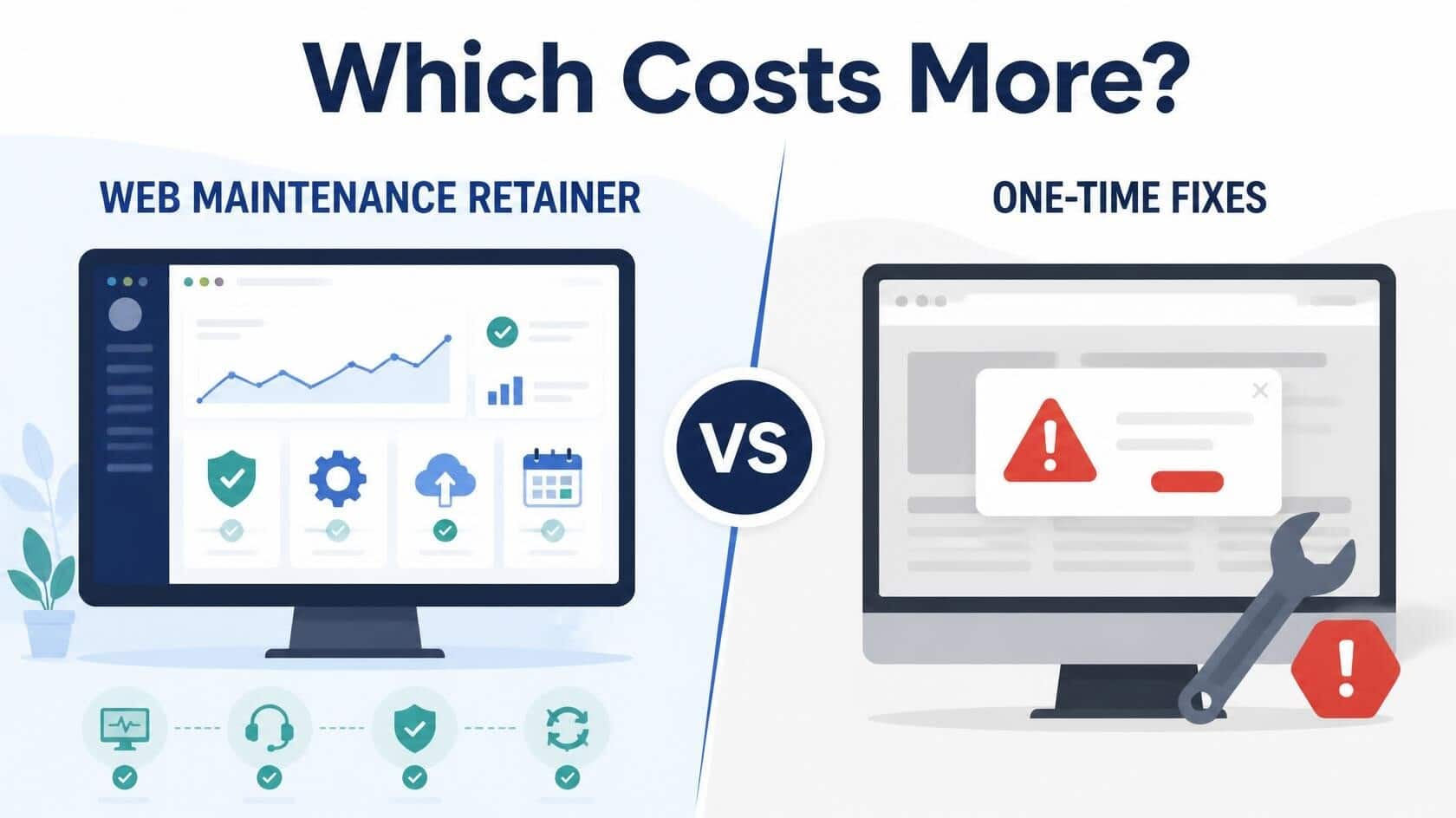
The price you pay is only one part of the equation.
To figure out which option is more cost-effective, you also need to consider how often you need support, how quickly you need help, and what happens when maintenance is ignored.
Upfront and monthly costs
One-time fixes do not require a recurring payment. This can make them attractive to businesses with simple websites. If you only need a minor repair once or twice a year, paying for those specific jobs may cost less than paying for a maintenance plan every month.
A retainer, on the other hand, gives you a predictable recurring cost. You know how much you are paying each month and what services are included in your plan. This can make website expenses easier to budget for.
The tradeoff is that you are paying for ongoing support even during months when your website does not have a major problem. However, that does not necessarily mean you are paying for nothing.
A good maintenance plan can include routine updates, security checks, backups, monitoring, and other work that helps keep the website running properly.
Additional reading: WordPress Support Retainer: What It Is and Why Your Website Needs One
The cost of emergency repairs
Emergency website repairs can be more expensive than routine maintenance.
Imagine that your website goes down on a Monday morning. You have an important promotion running, or your sales team is sending potential customers to your website. You now need someone to investigate the problem quickly.
Finding an available developer at the last minute may be difficult. You may also have to pay a higher rate for urgent work.
With an ongoing maintenance retainer, you already have a support provider familiar with your website. Depending on the agreement, you may also have access to faster response times or emergency support.
That does not mean a retainer prevents every emergency. Websites can still experience unexpected problems. But having someone responsible for the site can make it easier to respond when something does happen.
The value of preventive maintenance
One of the biggest differences between the two models is prevention.
One-time support usually starts when something has already gone wrong. Ongoing maintenance gives you the chance to address smaller issues before they become bigger ones.
For example, keeping plugins and software updated can reduce certain security and compatibility problems. Regular backups can give you a way to restore your website if something goes wrong. Uptime monitoring can alert you when your website becomes unavailable.
None of these services guarantees that your website will never have a problem. They simply reduce the risk and make problems easier to manage. That can be valuable for a business that depends on its website every day.
The cost of your time
There is another cost that is easy to overlook: your time.
A business owner may spend hours trying to figure out why a website is not working. Even if you eventually solve the issue, that time could have been spent on customers, sales, marketing, or other business tasks.
You may also need to find a developer, explain the problem, provide access, answer questions, and wait for the work to be completed. With a maintenance retainer, you have someone who already knows your website and can handle many of these tasks for you.
For some businesses, that convenience alone can make ongoing support worth the cost.
If website issues are taking time away from running your business, we can help take those tasks off your plate. Our website support services handle routine maintenance, troubleshooting, and other technical tasks so you do not have to deal with everything yourself.
When Is a Website Maintenance Retainer More Cost-Effective?
A website maintenance retainer is not the right choice for every business. However, it can make more financial sense when your website is an important part of your business.
Consider ongoing maintenance if:
Your website generates leads or sales
If customers use your website to contact you, request quotes, schedule appointments, or buy products, even a short period of downtime can affect your business. In this situation, website maintenance is not simply a technical task. It is part of protecting an important business asset.
Your website changes often
Websites that receive frequent updates generally need more support. You may regularly add pages, update content, change forms, install plugins, or make other adjustments. Paying for each small task separately can become inconvenient and expensive over time.
You use WordPress with multiple plugins
WordPress websites often rely on themes and plugins to add features. Those tools need to be updated. Sometimes an update can create a conflict with another plugin or part of the website. If you do not have the technical knowledge to troubleshoot these issues, ongoing support can save you time and stress.
You do not have an in-house website manager
Not every business needs to hire a full-time webmaster. For a small or growing business, an ongoing support plan can provide access to website expertise without the cost of adding a full-time employee.
You can have someone handle regular maintenance and technical tasks while your team focuses on running the business.
You cannot afford extended downtime
If every hour your website is offline could mean lost customers, a proactive maintenance plan may be a better fit. The cost of support should be weighed against the potential cost of a website problem.
If your website plays an important role in bringing in customers, having ongoing support can give you one less thing to worry about. SetMySite can handle regular website maintenance and help when technical issues come up. Reach out to us today!
When Do One-Time Website Fixes Make More Sense?

A maintenance retainer is not automatically the cheaper option. For some businesses, one-time support is perfectly reasonable. You may not need a retainer if:
- Your website is small and simple
- You rarely make website changes
- Your website does not generate many leads or sales
- You already have someone on your team who handles maintenance
- You only need occasional technical assistance
- Your website has been stable and requires very little ongoing work
For example, a simple informational website that rarely changes may only need occasional updates or repairs. In that case, paying for individual services as they come up could be more practical than committing to a monthly plan.
Tip: Look at your actual needs rather than choosing based on price alone.
Hidden costs of only paying for website fixes
The biggest problem with the one-time approach is that the invoice is not always the full cost. There can be other expenses that are harder to see.
Small problems can become bigger problems
Ignoring a small issue does not always cause serious damage. But sometimes it does.
A broken plugin, outdated software, or security warning may be easy to address early. If it is ignored, it could eventually cause a larger problem that takes more time and money to fix.
Emergency work can disrupt your business
A website problem rarely happens when you have plenty of free time. If your site breaks during a busy period, you may have to stop what you are doing to find help. You could also lose leads or sales while the issue is being resolved.
You pay more for urgent help
When you only hire help after a problem appears, you may have less control over timing. If the problem is urgent, you may need to accept whatever the provider is available rather than comparing options and choosing the best fit.
You may keep starting from scratch
If you work with different developers for different problems, each person may need time to understand your website. An ongoing provider already has a working relationship with you and should become familiar with your site’s setup, tools, and history.
Read more: Uptime Monitoring vs. Visual Monitoring: Which One Does Your Website Need?
How to Decide Which Option Is Right for Your Website
There is no universal answer. Instead, ask yourself a few questions:
- How important is your website to your business?
- How often do you need website help?
- What happens if your website goes down?
- Do you have someone who can handle technical problems?
- How much time do you spend managing your website?
- Can you handle an unexpected repair bill?
Ultimately, the cheapest option on paper is not always the most cost-effective option.
What Should a Website Maintenance Retainer Include?
If you decide to look for a web maintenance retainer, do not compare providers based only on their monthly price. Look at what you actually receive for that price.
Depending on your needs, a maintenance plan may include:
- WordPress and plugin updates
- Website backups
- Security monitoring
- Malware scanning
- Uptime monitoring
- Website performance checks
- Bug fixes
- Content updates
- Technical troubleshooting
- Emergency support
- Monthly reports
Also check whether the plan includes a set number of support hours and whether unused time rolls over. It is worth asking what happens when you need work that goes beyond the included services.
Some providers charge an additional hourly rate, while others have higher-tier plans for more complex work. The goal is to find a plan that matches your website instead of paying for services you will never use.
Website maintenance plans from SetMySite
SetMySite offers three plans based on how much support your website needs:
- Upkeep – $129/month: WordPress updates, uptime monitoring, malware scans, firewall protection, backups, and emergency care. Includes 60 minutes of support time per month, with up to 2 hours available through rollover.
- Webmaster – $249/month: Everything in Upkeep, plus a dedicated website manager, phone or video support, more monitoring, daily backups with 90-day history, and monthly reports. Includes 120 minutes of support time, with up to 4 hours rollover.
- Advanced: Built for more complex websites, including eCommerce, memberships, integrations, and custom development. Includes 180 minutes of support time, with up to 6 hours of rollover.
This gives businesses the option to choose a maintenance plan based on their website’s needs and the level of support they want.
Is a Web Maintenance Retainer Worth the Cost in 2026?
For some businesses, yes.
A website maintenance retainer can be a cost-effective option when your website needs regular attention, generates business, or would be expensive to repair after a major problem.
It gives you a predictable way to handle routine maintenance and access help when you need it. More importantly, it can shift your website strategy from simply fixing problems to preventing them where possible.
That does not mean every business needs a monthly retainer. If you have a small website that rarely changes and only needs occasional help, one-time fixes may still be the better choice.
The right option comes down to how much your website matters to your business and how much support it actually needs.
If you would rather not spend your time dealing with updates, security checks, website errors, and other technical tasks, ongoing website management can take those responsibilities off your plate. A website management service can handle routine maintenance and provide support when something needs attention.
Instead of waiting for your website to break and then looking for someone to fix it, you can have a team already familiar with your site and ready to help.
Conclusion
Your website is part of your business, so it should not be something you only think about when something goes wrong. Even small issues can take time to deal with and pull your attention away from more important work.
The right approach is one that fits your website, your budget, and how much support you actually need. If you want someone to handle regular maintenance and help when issues come up, a web maintenance retainer can take some of that work off your plate.
Ready to spend less time managing your website? Contact us today to find the right maintenance plan for your needs.